Brand deals guide
Influencer contract checklist: what to agree before you post
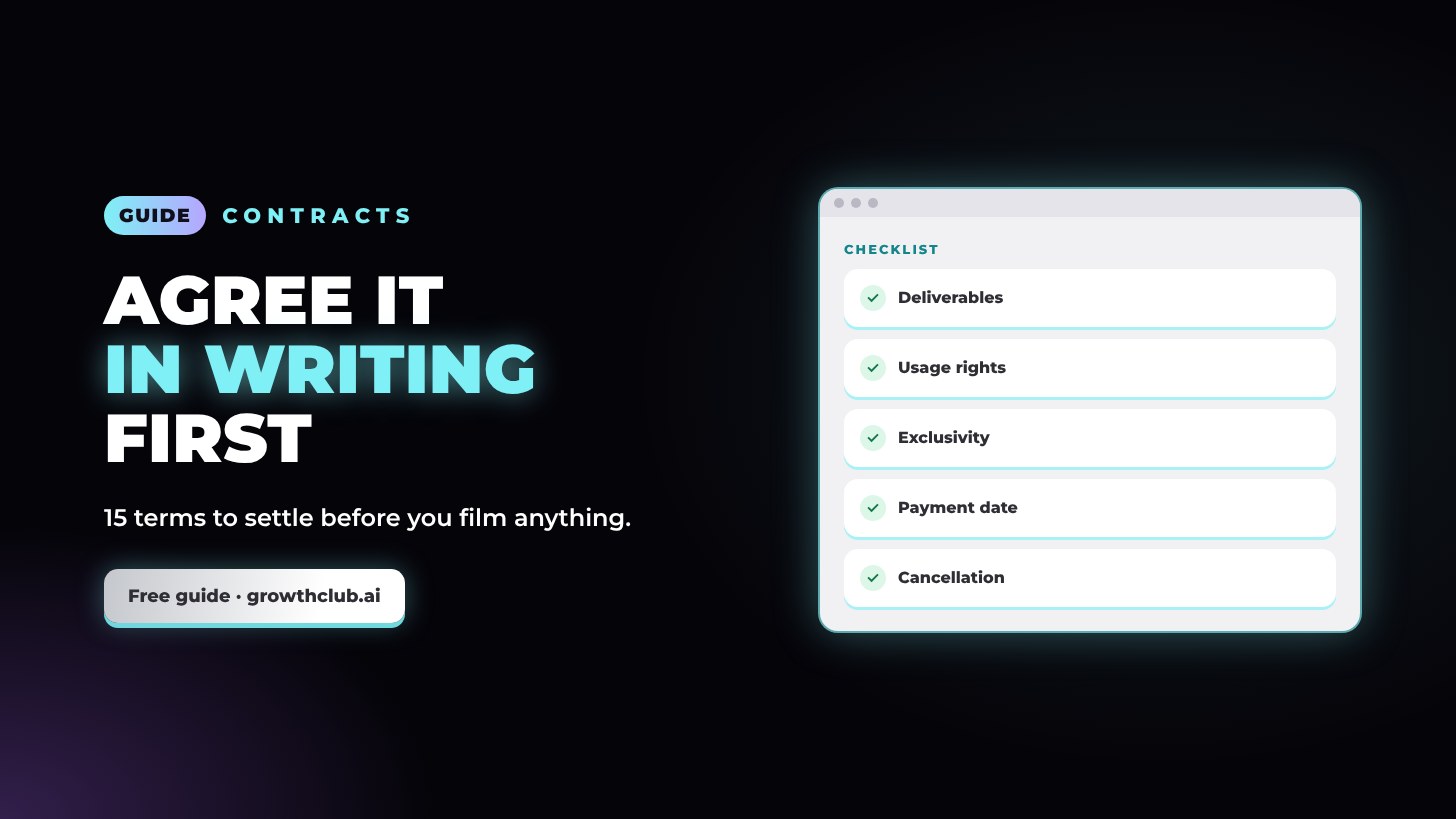
Before you post anything for a brand, agree the deal in writing: what you’ll deliver and when, how many revision rounds are included, whether the brand can run your content as ads and for how long, any exclusivity, the fee and payment date, and what happens if the brand cancels. For small deals, a clear confirmation email is usually enough. For bigger ones, use a proper contract. Here’s the checklist.
This guide explains common terms so you know what to look for. It isn’t legal advice. For large deals, long exclusivity or anything you’re unsure about, ask a lawyer who works with creators.
The 15 terms to agree
1. Who the deal is between
Your legal name or company, the brand’s legal entity, and the agency if one is involved. Check who actually pays you: it’s often the agency, not the brand. If you’re under 18, a parent or guardian will usually need to sign the contract with you and may need to handle payment.
2. Deliverables
Be exact: platform, format, number, length and extras. “1 Instagram Reel (30 to 60 seconds), 3 Stories with a link sticker, link in bio for 7 days” leaves no room for surprises.
3. Key messages and what you won’t say
Agree the brand’s must-mention points, and note anything you won’t do (for example, no claims you can’t verify, no script read word for word).
4. Timeline
Dates for the brief, your draft, feedback, final approval and posting. Note what happens if the brand gives feedback late: the posting date should move, not your other commitments.
5. Approval and revisions
How many revision rounds are included (one or two is standard) and what counts as a revision versus a new brief. Extra rounds should be paid.
6. Usage rights
This is the most important clause after the fee. Agree:
- Organic use: can the brand repost your content on its own channels?
- Paid use: can it run your content as ads (whitelisting, Spark Ads, partnership ads)?
- Duration: 30, 60 or 90 days is typical. Avoid “perpetual” without a big fee.
- Platforms and territories: which apps and countries.
Paid usage is usually charged on top of your fee. See how to price usage rights.
7. Access to your account
If the brand wants to run ads through your handle (whitelisting or partnership ads), agree exactly what access they get, for how long, and that you can revoke it at the end. Never share your password: use the platform’s own partnership tools.
8. Exclusivity
If you can’t work with competitors, the contract should name the category (or the brands), the platforms and the period, for example “no other haircare brand on Instagram and TikTok for 30 days after posting”. Exclusivity is a cost to you, so it should come with a fee.
9. Fee and what it covers
The fee, currency, whether VAT or sales tax is added, and exactly what it includes (deliverables, usage period, exclusivity). If expenses like travel or props are covered, say so.
10. Payment terms
When you’re paid (for example, within 14 or 30 days of posting), how (bank transfer, PayPal), and whether there’s a deposit. Agree a late-payment clause in the contract and repeat it on your invoice.
11. Cancellation and kill fee
If the brand cancels after you’ve started, you should be paid for work done. A common approach is 50% if cancelled after the brief is approved and 100% once content is delivered.
12. Content ownership
Usually you keep ownership of your content and license it to the brand. If they want to own it outright (a buyout), that’s a much bigger fee.
13. Disclosure
Both sides should agree the content will be clearly labelled as an ad, using the platform’s paid partnership tool and an “Ad” label. In the UK and US, creators are responsible for disclosure too. See our guide to #ad rules.
14. Performance reporting
What stats you’ll share, and when (for example, screenshots of reach, views, link clicks and saves 7 days after posting).
15. Termination and conduct clauses
When either side can end the deal early and what happens to payment. “Morality” clauses let a brand end the deal over behaviour that harms its reputation: make sure the wording is specific and works both ways.
Red flags to push back on
- Perpetual, worldwide, all-media usage for an organic-post fee.
- Exclusivity longer than the campaign with no extra fee.
- Unlimited revisions or approval “at the brand’s sole discretion”.
- Payment “after the campaign ends” with no date.
- Ownership transfer of your content or likeness.
- Performance-only pay (paid only if sales hit a target) without a base fee.
A simple deal confirmation for small deals
For a small, one-off deal, you don’t need a 10-page contract. Send a confirmation email and ask the brand to reply “agreed”:
Subject: Confirming our partnership: [Brand] x [Your name]
Hi [First name],
Great to be working together! Confirming what we agreed:
- Deliverables: [e.g. 1 Reel (30 to 60s) + 3 Stories with link]
- Draft by: [date] · Posting date: [date]
- Revisions: [1 round] included
- Usage: organic reposting on [Brand]’s channels; paid usage not included (available at [rate] per 30 days)
- Exclusivity: none
- Fee: [amount + currency] (+ VAT if applicable), [50% now, 50% on posting / within 14 days of posting]
- Cancellation: [50% after brief approval, 100% after delivery]
- Disclosure: Paid partnership label and “Ad” in the caption
Please reply “agreed” and I’ll get started. Invoice details below:
[Name, address, bank or payment details]
Thanks!
[Name]
Frequently asked questions
Do I need a contract for a brand deal?
You need the terms in writing. For small, one-off deals, a confirmation email the brand replies to is usually enough. For larger fees, paid usage, exclusivity or long-term deals, use a written contract and consider asking a lawyer to check it.
Who writes the contract?
Usually the brand or agency sends one. Read every clause, mark changes and send it back. If you work with brands often, keep your own simple terms to send when the brand doesn’t have any.
What usage rights should I give?
Organic reposting is often included in your fee. Paid usage (ads) should be time-limited, usually 30 to 90 days, and charged on top. Avoid perpetual usage unless you’re paid a buyout fee.
What is a kill fee?
A payment if the brand cancels after you’ve started. It protects the time you’ve already spent, for example 50% after the brief is approved and 100% once you’ve delivered.
What happens if a brand doesn’t pay?
Send a polite reminder with your invoice on the due date, then a firmer one with your late-payment terms. Keep everything in writing. If it still isn’t paid, a formal letter before action or a small claims process is the next step (ask an adviser where you live).
Good to know: this guide is general information, not legal, tax or financial advice. Rates and earnings are estimates, not promises, and platform rules change, so check the official pages we link to. Instagram, TikTok, YouTube, Facebook, Threads, X, LinkedIn and the other names mentioned are trademarks of their owners; Growth Club isn’t affiliated with or endorsed by them.