Brand deals guide
#ad rules: how to disclose sponsored posts in the UK and US
If a brand paid you, gave you something for free, or you earn commission from a link or code, label the content clearly as an ad, upfront, before anyone has to tap “more”. Turn on the platform’s paid partnership label and also put “Ad” at the start of your caption, and say or show it in videos. That meets the main UK and US guidance. Here are the details, with examples for each format.
This guide summarises official UK and US guidance as of October 2026. Rules can change, so check the sources linked below for anything you’re unsure about.
The short version
- Paid, gifted, affiliate, discount codes, your own products: all need a label.
- Use “Ad” or “#ad” at the very start of the caption or on screen.
- Turn on the platform’s label (Paid partnership, Content disclosure, Includes paid promotion).
- In videos, say it or show it in the video itself, not only in the caption.
- On every Story frame that features the brand.
- Don’t hide it in a pile of hashtags, your bio or after the “more” cut-off.
UK rules
Two bodies set the rules in the UK: the Advertising Standards Authority (ASA), which enforces the advertising code, and the Competition and Markets Authority (CMA), which enforces consumer law.
What counts as an ad. Under the ASA’s guide, content is an ad when a brand gave you something of value (money, free products, trips, commission) and had some control over it (approval, required messages, timing). Affiliate links, discount codes, your own products and brand giveaways count too (ASA influencers’ guide).
Gifts count under consumer law too. The CMA’s updated guidance (September 2025) says any incentive, including free products, needs a clear, upfront “Ad” or “#Ad”, whatever your follower count and even when you weren’t obliged to post. Tagging the brand, a discount code or an affiliate link is not a disclosure on its own (CMA guidance).
Labels to use: “Ad”, “#ad”, “Advert”, “Advertisement”. Labels the ASA and CMA advise against: “Sponsored”, “#spon”, “#gifted” or “Gift”, “#collab”, “#aff” or “Affiliate”, “Thanks to [brand]”, “In association with”, “#brandambassador”.
Ongoing relationships: if you’re a brand ambassador, disclose throughout the relationship and in relevant content for 12 months after it ends (ASA).
The stakes went up in 2025. Since April 2025, the Digital Markets, Competition and Consumers Act 2024 lets the CMA decide breaches itself and fine businesses up to £300,000 or 10% of global turnover, whichever is higher (DMCC Act, s.182). Undisclosed paid promotion and reviews that hide an incentive are among the practices banned outright (DMCC Act, Schedule 20).
US rules
The Federal Trade Commission (FTC) enforces the rules in the US through its Endorsement Guides, updated in 2023 (eCFR Part 255).
- Disclose any “material connection”: payment, free or discounted products, a job, or a family or personal relationship with the brand. Free products count even if you weren’t asked to post.
- Make it “clear and conspicuous”: hard to miss and easy to understand. On social media that means in the post itself, not only in your bio, behind “more” or in a cluster of hashtags.
- In videos, say it and show it in the video, not only in the description. Repeat it during livestreams.
- Good labels: “Ad”, “Advertisement”, “Sponsored”, “#ad”, “#sponsored”. “Sponsored by [Brand]” is clearer than “Sponsored” alone.
- Unclear labels: “sp”, “spon”, “collab”, “thanks”, “ambassador” on their own, and “gifted” on its own (FTC: Disclosures 101, FTC FAQs).
- Affiliate links: say something like “I earn a commission on purchases through these links”, near the links. “Affiliate link” alone may be unclear.
US rules can apply to creators outside the US if it’s reasonably foreseeable that the content will affect US consumers.
The FTC accepts “#sponsored”, but the UK’s ASA and CMA advise against it. If your audience is in both countries, use “Ad” or “#ad”: it works everywhere.
Platform tools: use them, but add your own label
| Platform | Tool | Enough on its own? |
|---|---|---|
| Instagram and Facebook | Paid partnership label (tag the brand) | Required by Meta’s branded content policy. Add “Ad” upfront too |
| TikTok | Content disclosure setting: “Branded content” shows “Paid partnership” | Required by TikTok for promotional posts. Add “Ad” on screen or in the caption |
| YouTube | “Includes paid promotion” in YouTube Studio | Shows a short label at the start. Also say it in the video |
The UK regulators say a platform label can be enough if it’s upfront, prominent and clearly says it’s an ad, but recommend adding “Ad” if in doubt. The FTC says it’s “always best to add your own disclosure” even if a platform offers its own tool.
Examples for each format
Instagram Reel or TikTok (paid): turn on the platform label, start the caption with “Ad |” and add an “Ad” text overlay in the first seconds, or say “This is an ad for [Brand]” at the start.
Instagram Story (gifted, UK): add “Ad” in large text at the top of every frame that shows the product.
YouTube integration: tick “Includes paid promotion”, say “This video includes an ad for [Brand]” at the start and again before the segment, and put “Ad: sponsored by [Brand]” near the links in the description. If the whole video is an ad, put “Ad” in the title or thumbnail too.
Affiliate link in a caption or description: “Ad: I earn a commission if you buy through these links” next to the links.
Discount code: “Ad: use my code [CODE] for 15% off ([Brand] pays me commission).”
Disclosure checklist
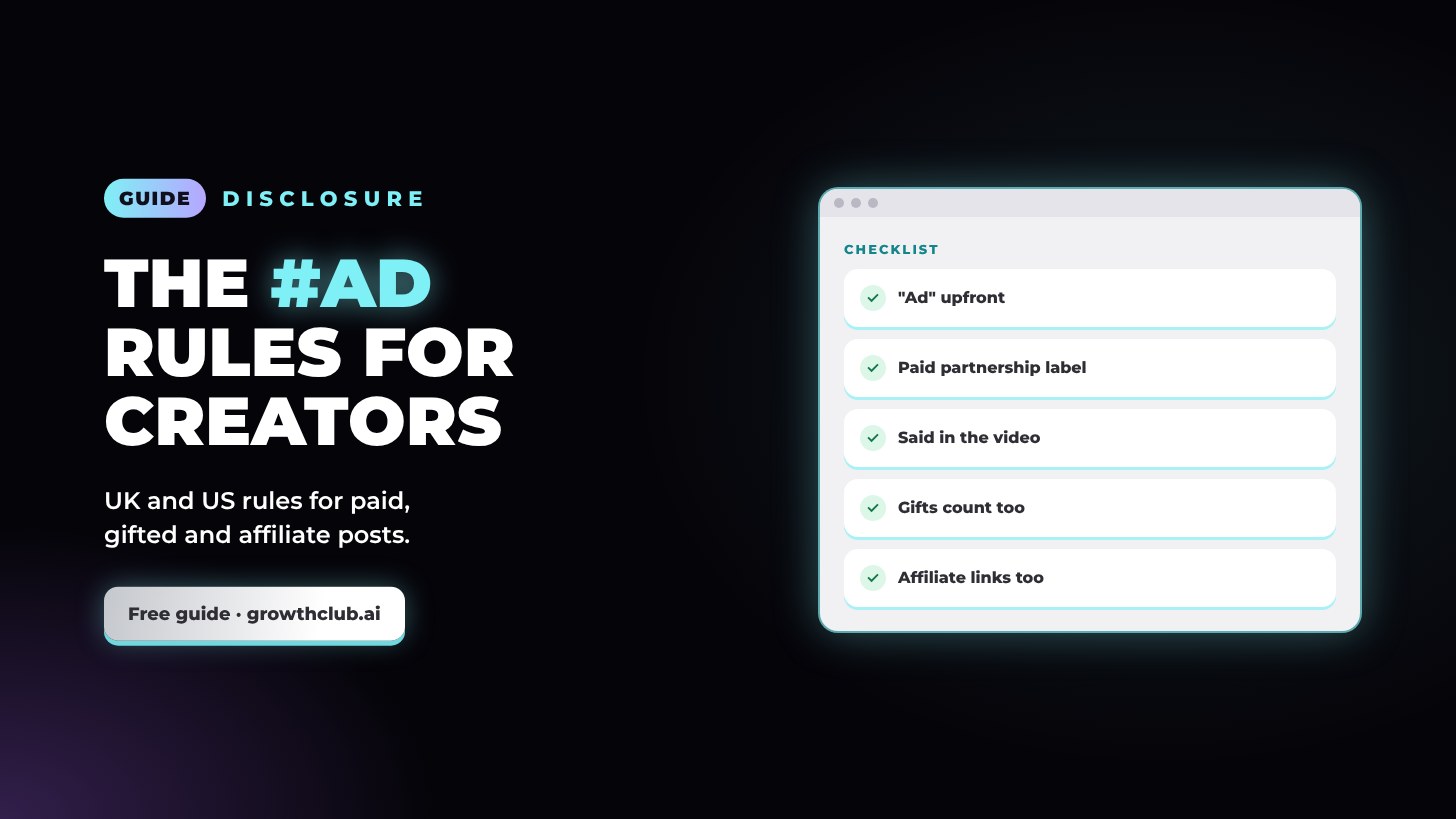
- Label is at the start, visible without tapping “more”
- Platform’s paid partnership tool is on
- Video says or shows “Ad” or “sponsored” in the first seconds
- Every Story frame is labelled
- Gifted and affiliate content labelled too
- The brand’s contract doesn’t ask you to hide the relationship
Frequently asked questions
Do I need to put #ad on gifted products?
In the UK, yes: the CMA says free products are an incentive that needs an upfront “Ad” label. In the US, you must clearly disclose free products: “#ad” works, and so does “Thanks to [Brand] for the free product” if the product is all you got.
Is the Instagram paid partnership label enough?
Use it, and add “Ad” at the start of your caption as well. UK regulators say the label can be enough if it’s clear and prominent, but recommend adding “Ad” if in doubt; the FTC recommends adding your own disclosure.
Where should #ad go in a caption?
At the very start, before anything else and above the “more” cut-off. A label at the end of a caption or among other hashtags is easy to miss.
Do affiliate links need to be disclosed?
Yes, in both the UK and US. Label the content as an ad upfront and make it clear you earn commission. A general “links may be affiliate” note isn’t enough.
What happens if I don’t disclose?
In the UK, the ASA can name you on its non-compliance list, and the CMA or Trading Standards can take enforcement action. Since April 2025, the CMA can fine businesses directly. In the US, the FTC can take action against brands and creators. Platforms can also remove or restrict undisclosed branded content.
Good to know: this guide is general information, not legal, tax or financial advice. Rates and earnings are estimates, not promises, and platform rules change, so check the official pages we link to. Instagram, TikTok, YouTube, Facebook, Threads, X, LinkedIn and the other names mentioned are trademarks of their owners; Growth Club isn’t affiliated with or endorsed by them.