Brand deals guide
How to get brand deals as a small creator
You don’t need a huge following to get paid by brands. Brands pay for an audience that matches their customers and content that people actually watch, so small creators can land deals by picking a clear niche, packaging their numbers, pitching the right person with a specific idea and following up. This guide walks you through each step, in order.
What brands are actually buying
Before you pitch anyone, it helps to know what a brand is paying for. It’s rarely your follower count on its own. A brand manager is asking three questions:
- Fit: does your audience look like their customers (age, location, interests)?
- Attention: do people watch, save and comment on what you post?
- Reliability: will you deliver on time, follow the brief and make something they’re proud to share?
Brands increasingly say fit matters more than reach. CreatorIQ’s 2026 survey of 5,095 creators found that about one in five said 2026 was their first year working with brands, which suggests plenty of newer creators are getting booked (Marketing Dive, Aug 2026).
It also helps to know what a typical deal looks like. On Collabstr’s marketplace, the average final payout per collaboration in 2025 was $193 on Instagram, $186 on TikTok and $255 on YouTube, and 80% of deals were under $300 (Collabstr 2026 report). Your first deals will probably be modest. That’s normal, and they’re how you build the proof that gets you bigger ones.
Step 1: Pick a niche a brand can picture
Brands buy into a niche because it maps to their products. “Lifestyle” is hard to sell. “Budget skincare for oily skin”, “home workouts for new mums” or “first-time renters decorating on a budget” are easy, because a brand instantly knows whether its product fits.
A good niche is:
- Specific enough that a brand can name its product in your content.
- Broad enough that at least 30 to 50 brands sell into it.
- Something you can post about every week without running out of ideas.
You don’t have to be locked in forever. Pick the lane you’re already strongest in and make your next 20 posts sharper.
Finance, health, supplements, beauty, alcohol and gambling have extra advertising rules, so check them before you take a deal in these niches. In the UK, promoting most investments without FCA approval can be a criminal offence.
Step 2: Get your numbers ready
Brands will ask for numbers, and answering quickly makes you look professional. Have these ready for each platform:
| Number | Where to find it | Why brands care |
|---|---|---|
| Followers | Your profile | A rough sense of reach |
| Average views (last 10 to 15 posts) | Insights or analytics | What a sponsored post will realistically get |
| Engagement rate | Likes, comments, shares and saves ÷ followers or views | Whether people care |
| Top countries and cities | Audience insights | Whether they can sell to your viewers |
| Age and gender split | Audience insights | Whether your viewers are their customers |
Use average views from your recent posts, not your one viral hit. Brands check, and an honest number builds trust. Not sure what your engagement rate is? Work it out with our engagement rate calculator.
Step 3: Package your proof
A brand should be able to understand who you are in 30 seconds. That’s what a media kit is for: one or two pages with your niche, audience, numbers, past work and contact details. Add a portfolio if you have content you’re proud of, even if it’s unpaid.
If you’ve never worked with a brand, show content you made as if it were sponsored: a product you genuinely use, filmed and edited the way you’d do it for a client. That’s what brands want to see. Just don’t present it as a paid partnership if it wasn’t one.
Our guide on how to make a media kit covers exactly what to include.
Make a pitch-ready media kit in minutes: 12 ready-made looks, your stats and rates, a QR code, a share link and a PDF download. Brands only ever see you.
Create my account and try itIt’s free with a Growth Club account.Step 4: Find brands that already pay creators
The fastest yeses come from brands that already work with creators, because they have a budget and a process. Signs a brand pays creators:
- Their posts and stories reshare creator content or tag creators.
- Creators in your niche post content for them with an Ad or Paid partnership label.
- They run an affiliate or ambassador programme (search “[brand] ambassador” or “[brand] affiliate”).
- They’re a direct-to-consumer brand that sells online and runs social ads.
Start with brands whose products you already use, then their direct competitors, then the brands your favourite creators in the same niche work with. Our guide on finding brands to work with goes deeper.
Step 5: Pitch the right person with a specific idea
Generic messages (“Hi, I’d love to collaborate!”) get ignored. A pitch that lands is short, personal and specific:
- Who you are and who watches you, in one line.
- Why this brand, in one line (show you know their product).
- One concrete content idea, with the format.
- One proof point (average views, a result, a past brand).
- A simple next step.
Send it to the person who runs creator partnerships (often titled influencer marketing, creator partnerships, social or brand partnerships manager), not a general inbox, when you can. Email beats DMs for paid deals because it’s easier to forward internally. Use business email addresses only, never personal ones. You’ll find full templates, and the email rules to follow, in our guide on how to pitch brands.
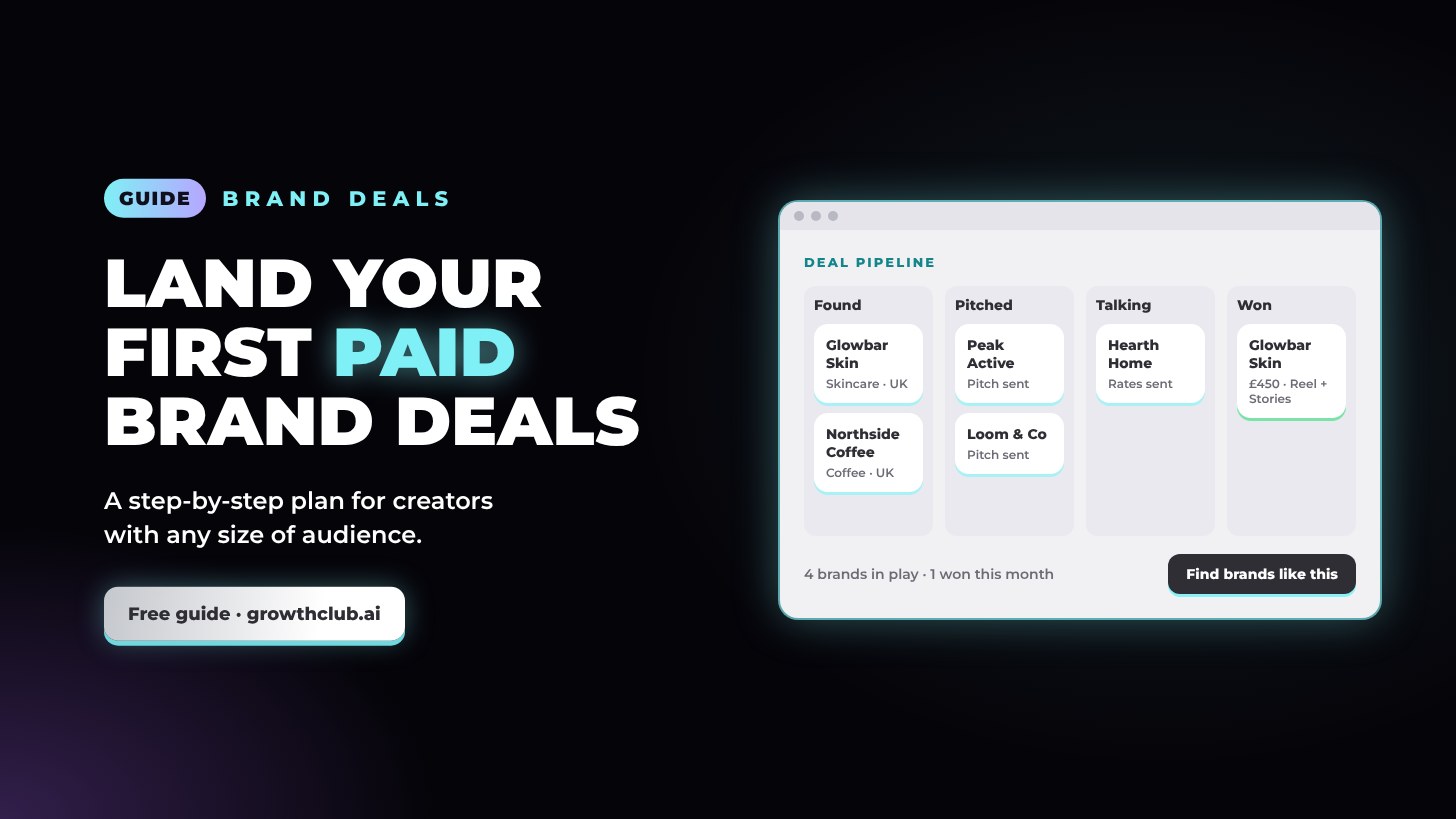
Find brands in your niche, get the contact details they publish, such as partnership and press emails, send ready-written pitches from your own email and track every deal in one pipeline.
Create my account and try itIt’s free with a Growth Club account.Step 6: Follow up (most deals happen here)
Brand teams are busy, and the first email often gets buried. Follow up twice:
- Follow-up 1 (4 to 5 days later): reply in the same thread with a new angle or a fresh stat.
- Follow-up 2 (a week after that): keep it to two lines and make it easy to say yes or no.
After that, move on and try again next quarter, unless they’ve asked you not to contact them. Track who you’ve contacted and when, so you never double-pitch or forget a reply.
Step 7: Price it and agree the details
When a brand says yes, they’ll ask your rate. Have a number ready for each format, based on your average views and engagement, not a guess. Our guide to influencer rates shows the methods and current benchmarks, and the rate calculator gives you a starting range in seconds.
Before you post, agree in writing:
- Deliverables (format, number of posts, stories, links).
- Timeline and approval rounds.
- Usage rights (can they run your content as ads, and for how long?).
- Exclusivity (are you blocked from working with competitors?).
- Payment amount, currency and due date.
Our contract checklist covers every point.
Step 8: Deliver well and get rebooked
Repeat deals are easier and better paid than new ones. To get rebooked:
- Hit the deadline and follow the brief, then add one idea of your own.
- Disclose the partnership clearly (see our guide on #ad rules).
- Send a short results recap within 7 days: views, engagement, link clicks, codes used, and two or three standout comments.
- Suggest a next idea while the campaign is still fresh.
Common mistakes that cost small creators deals
- Pitching brands that don’t fit your audience. A great creator in the wrong niche still gets a no.
- Leading with follower count. Lead with who your audience is and what they do.
- Sending a media kit with old numbers. Update it monthly.
- Saying yes to everything for free. Gifted collaborations can help early on, but set a limit (see gifted collaborations).
- Not following up. Many deals come from the second or third email.
Frequently asked questions
How many followers do you need to get brand deals?
There’s no official minimum for direct deals. Brands work with creators of every size, and smaller creators often get booked for niche audiences and strong engagement. Some platform marketplaces do set minimums, for example 1,000 followers for TikTok One projects. See how many followers you need.
Do brands pay small creators?
Yes. Most paid deals are small: on Collabstr, 80% of collaborations in 2025 paid under $300. Small creators with a clear niche and good engagement can get paid, especially for short-form video and UGC.
How much should I charge for my first brand deal?
Base it on your average views and engagement, not followers alone. A common starting point is about $10 (roughly £8) per 1,000 followers for an Instagram post, or a CPM on your average views for video. Use our rate calculator for a range.
How do I get brands to contact me?
Make it easy: put a clear niche and a business email in your bio, keep a media kit link handy, post the kind of product content a brand would pay for, and tag brands whose products you genuinely use. Inbound offers grow once brands see you doing paid work well.
Is it better to email or DM brands?
Email, for paid deals. It reaches the person who controls the budget, it’s easy to forward internally, and it keeps terms in writing. DMs can work for small brands where the founder runs the account and invites collab requests.
Good to know: this guide is general information, not legal, tax or financial advice. Rates and earnings are estimates, not promises, and platform rules change, so check the official pages we link to. Instagram, TikTok, YouTube, Facebook, Threads, X, LinkedIn and the other names mentioned are trademarks of their owners; Growth Club isn’t affiliated with or endorsed by them.